About My Work
Philosophy & Vision
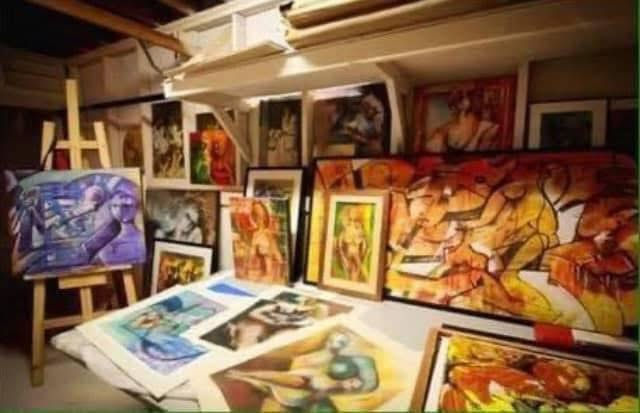
Gildalorena's studio in El Paso, Texas, 2011. Credit: Manny Madole
My work is born from what I see and what I feel: I absorb the world around me and render it on canvas, stripped bare and amplified. It often presents a tension between dualities: chaos and structure, the abstract and the figurative, the outer world and inner life. I am a sensitive being, and each of my pieces reflects fragments of my joys, fears, vanities, pain, losses, and pride.
This practice has crystallized into several pictorial series that often explore woman as an active force who loves, cares, suffers, observes, dreams, and celebrates; the family as a source of connection and disconnection; the transformation of societies marked by violence; the homeland we always carry within; and the mark left on us by circumstances beyond our control.

Gildalorena preparing the installation of her exhibition, City of Sand and Blood, at the Mexican Chamber of Representatives in Mexico City.

Gildalorena in her studio in Ciudad Juárez. Credit: Associated Press.

Workshop with artist Gilberto Aceves Navarro.

Gildalorena and her children in Ciudad Juárez.

A winter landscape that Gildalorena painted shortly after her father's murder.
_JPG.jpg)
Gildalorena, 4, during Three Kings Day in Mexico City.
Artistic journey
My Life in My Words
My name is Gildalorena, and without false modesty, I have always been an artist. In my work, as in my life, I am honest, passionate, steadfast, and radical. The way I am has brought me happiness, adventure, and more than a few clashes and consequences, which I have accepted without complaint. I am sparing with tears — I cry only for death — and generous with laughter, because deep down I will always be a rebellious, mischievous, and boastful little girl.
I was born in Mexico City in a year whose number I prefer not to remember. I was a sleepy, relaxed, and carefree child, always with an awe-struck look on my face, mouth slightly agape, and large, analytical, contemplative eyes. I am the second of three daughters. My mother was a homemaker, a perfectionist, and a demanding woman with a strong character. She eventually became a respected judge. My father at the time worked in the mining industry, where he was already emerging as a union leader, a position that would eventually lead him to become a federal congressman for the State of Mexico. Both were hardworking and ambitious. In time, they would pay the price for it.
I had a happy and protected childhood. Even then, my vocation for painting and my preference for my father were evident. At the age of seven, I painted my first oil painting — a man with a cane outside a cabin, surrounded by ducks and a lake — which I still keep.
I learned basic concepts such as color theory at an art academy. I carried out my own experiments during class and disliked it when the teacher held my brush for more than a few seconds. I left a few months later, prompted by my poor grades in school. I continued painting alone at home, the context where I have always belonged. I painted countless landscapes, flowers, fruit, and clowns.
The person I loved most was my father, but he worked constantly and I hardly saw him. I did not interact much with my sisters and preferred to avoid my mother, whose unhappiness was increasing and manifested itself through aggression and emotional distance. I isolated myself from my parents’ arguments through music and painting. My creative and playful spirit has never left me, and I entertained myself with choreographies, impressions, and radio dramas.
After finishing high school, I sought admission to a professional art academy, but my father convinced me to go to university, telling me that an artist’s life is not easy and that a degree would be a good tool for my future. I followed his advice, but I continued making art, making copies of Renaissance paintings and visiting cultural spaces. The Mexican muralist David Alfaro Siqueiros, with his bold colors and confident brushwork, became the main influence on my mature work.
The most crucial event of my life awaited me at the beginning of my university years.
"A sad farewell, a new beginning: in short, the story of many of us immigrants."
"I asked my mother where my father was and why we were not with him. Seeing how I had reacted, she decided to hide from me for a few hours that he had died."
I would not want this tragedy to define me, but it would be illogical not to mention it.
I was eighteen years old. One morning, as I was getting ready to go to the university, I went upstairs to my parents’ bedroom, gave my father a goodbye kiss as I did every morning, and told him I could not find my car keys (I was pretending; we had other vehicles that I liked better). He came downstairs, found the keys, and handed them to me, giving me an opportunity to kiss him a second and final time.
I spent that morning talking about my father with a friend. I remember mentioning the shirt he had worn the day before, when he attended the president's State of the Union address. My head felt heavy, not imagining what was happening at home, yet somehow sensing it.
I left school to run some errands when I ran into one of my father’s coworkers, who told me that my father had been in an accident.
I went home and left my car in the street. There were many people inside and outside the house. My brother-in-law at the time took me by the arm to lead me upstairs. I felt as if I were floating. In my parents’ bedroom, I saw my two sisters embracing. My mother was on the other side of the bed, her face contorted.
I crawled across the bed and asked what had happened. She told me, “Your father had an attempt on his life.” My mind had gone blank, and I asked, “What is an attempt on a life?” I fainted and never heard the answer. I woke up in my bed, smelling a piece of cotton soaked in alcohol. I asked my mother where my father was and why we were not with him. Seeing how I had reacted, she decided to hide from me for a few hours that he had died.
My father was murdered at the entrance of our home, shot at point blank. He was forty-seven years old. It was almost certainly a politically motivated crime, but as so often happens in Mexico, it was never solved. He knew he was in danger because the day before, he had shown me a place where he kept cash that he had set aside for me. He knew about my poor relationship with my mother and believed I would soon be out of the house. With that money, he hoped to ensure I could pay for shelter, food, and tuition.
I never saw him again. My mother requested that his coffin remain closed during the funeral mass. Everything felt alien to me, like a grotesque image. Leaning on my mother’s arm at the steps of that round chapel in the cemetery, I asked her again and again, “This isn’t true, is it? It’s a nightmare, isn’t it?” She answered, “Yes. Yes, it is.”
The cogwheel that had held the five pieces of that family together — and the security it gave me — had gone away. In the midst of my suffering and depression, between sedatives and fainting spells, I gave my mother the money my father had left for me. Months later, she threw me out of the house. She focused on her own grief, though at times I think part of her felt a certain relief after so much fighting during those final years.
I left with only a few belongings. I endured hunger, sexual harassment, and other hardships, exposed to the dangers that an enormous city often holds for a young woman on her own. Along the way I met people who offered me a hand, and many others who took it away. I had to start again from scratch, and this time, without my cornerstone, find support within myself. After several weeks of mostly sleeping, one clear goal emerged: to finish my degree and earn a diploma, like my father wished for. Eventually I did, something I have always been proud of.
Much later, as hard as it is to say, I came to understand the benefits of this tragedy. Events like these sometimes define your path. I now know that without it, I would not have graduated, and that degree was something I owed him — and myself.
I returned to painting months later. Inspired by a Christmas card that arrived at home, I painted a winter landscape in bluish-gray tones, with a frozen lake and an old mill lit by a faint glow. I poured my grief into it. I still keep that painting as well.
At the university, I learned new concepts in visual education. I did drawing assignments for my friends in exchange for materials, freelanced design work through some of my professors, and painted miniature landscapes to pay my tuition.
In the last year of my studies, I met the brother of one of my classmates. The attraction between us was immediate, and within two years we married, graduated, and I was pregnant with my first child. Of course, I named my son after his grandfather: Jesús.
My husband, my son, and I moved to Guadalajara, leaving my first skin behind in Mexico City. Distance separates you from everything, resets you, and allows you to start again. From my perspective as an artist, to move is to lengthen your life.
My son was four years old and demanded my attention. I paused my painting, though I continued making cartoon drawings for his bedroom and working on freelance illustrations and stained glass pieces.
I got pregnant for the second time, and we moved to Ciudad Juárez, where my husband had received a job offer. We fought often, and we divorced a year after arriving in this new city. Despite our problems, I never expected him to absent himself from our children’s lives, but that is what he did. I was the only family they had throughout their childhood and adolescence.
Alone, young, with a child in each hand, burdened by debts my ex-husband had left behind, and without a car, it was certainly not an easy time. But I never felt that my life then was a tragedy. Positive, cheerful, and armed with a dark sense of humor, I went out to work. Eventually, I opened my own advertising agency. I supplemented my income with sales and by teaching at a local university. I was cannon fodder in a dangerous border city, but divine protection, luck, and cunning helped me make it through unharmed. Lovely and kind, my children were the light that guided my path.
Years later, I remarried. That year was a respite, but the relationship became uncomfortable for my children, and I divorced once again. Returning to a traditional job was not an option, as I had developed a fibroid in my uterus that caused heavy bleeding and did not allow me to be away from home for more than an hour. That is how I started teaching painting classes to children in my home. In time, I had an average of seventy students and built a reputation as a respected children’s art teacher. Eventually, to the surprise of doctors, the fibroid disappeared through an act of pure faith and willpower.
This was when I returned again to my paint brushes. I had a suitable space, worked fewer hours, and my children were older, so I began painting almost every day.
Once, I took a workshop on the human figure with the renowned artist and teacher Gilberto Aceves Navarro. I remember hearing one of my classmates say we would all go back to doing the same thing once the course ended. I decided that would not be my case. I continued studying on my own in my studio until I finally found a language of my own, with which I presented my first solo exhibition at the Museo de Arqueología del Chamizal. That was the beginning of my career as a professional artist, and from there came further invitations to exhibit in different spaces across Mexico and the United States.
At that time, I visited Cuba with a handful of fellow Ciudad Juárez artists to exhibit our work. When I returned from that trip, my hometown had turned into chaos. It had been consumed by the conflict between two drug cartels fighting for control of the territory.
Violence and insecurity affected us all — there were kidnappings, extortion, robberies, and murders. Many families left the city, abandoning their homes. I had to close my beloved studio and move the few students I had left to an improvised space in my home.
A friend and her husband were two of my students. One day, they did not arrive for class. The businessman had been murdered outside his home under the same circumstances in which my father had lost his life. It was a tragedy that unearthed my own trauma, something I believed I had overcome after so many years.
With fear in my heart and the desolate atmosphere around me, I spent entire nights painting what was happening. This is how City of Sand and Blood was born, a series of more than thirty works through which I sought to document, in visual form, the collapse of the region that had adopted and sheltered me.
As the closing chapter of that cycle, I received an invitation to exhibit these paintings in Congress in Mexico City. My son accompanied me; by then, he had legally changed his surnames to those of my late father. In this way, the murdered congressman returned to that chamber to be honored by his daughter and grandson, who knew his grandfather only through my stories and the philosophy of life he left us as an inheritance. Those paintings were also my way of bringing the voice of the people of Ciudad Juárez before an absent government.
Upon returning, I took refuge for a year in El Paso, Texas, crossing the border with a forced exile on my back. Later I moved to San Antonio, where my daughter and her daughter live. I settled into a small downtown studio, where I painted several works for a new series on immigration titled Emma, in honor of my granddaughter. Meeting her was the great reason that brought me to this new land of a foreign tongue, representing a new love and a new role for me, but also marking a painful and abrupt end to one of the happiest periods of my life. A sad farewell, a new beginning: in short, the story of many of us immigrants.
After four years of helping my daughter care for the child, I moved to Austin with my son to begin a new home project. I resumed teaching painting classes, and ironically, my native language became my greatest advantage in that endeavor. I concluded this cycle by presenting my forty-seventh exhibition, Visions of Mexico, at the Consulate General of Mexico in Austin alongside some of my students.
During the pandemic, I alternated visits between San Antonio and Austin to care for my family. Within this new confinement, I continued painting, now studying my own work and discovering different perspectives, creating variations, exploring, and experimenting — as always, with complete freedom. That word, freedom, is precisely what has guided my life, despite the situations and conditions that have sometimes been imposed upon me: the freedom to be who I am and to choose my own path.
I have shared with the reader only some of the crucial events of my life. I hope that something in my story inspires you to achieve your own goals. Gratitude, perseverance, focus, and courage would be the essential ingredients for living a full life, as mine has been.
One final piece of advice: take risks, cross borders, step outside your comfort zone. That way, in the end, you will be able to say that you saw the many shades of life, that a dark and courageous line crossed the blank space, that you dared to erase something that was already good, and in the end everything became better because you had the guts. That is my work, and that is why I share it, just as I share these words: so that the world may see what I see.
GILDALORENA MARTINEZ, 2024